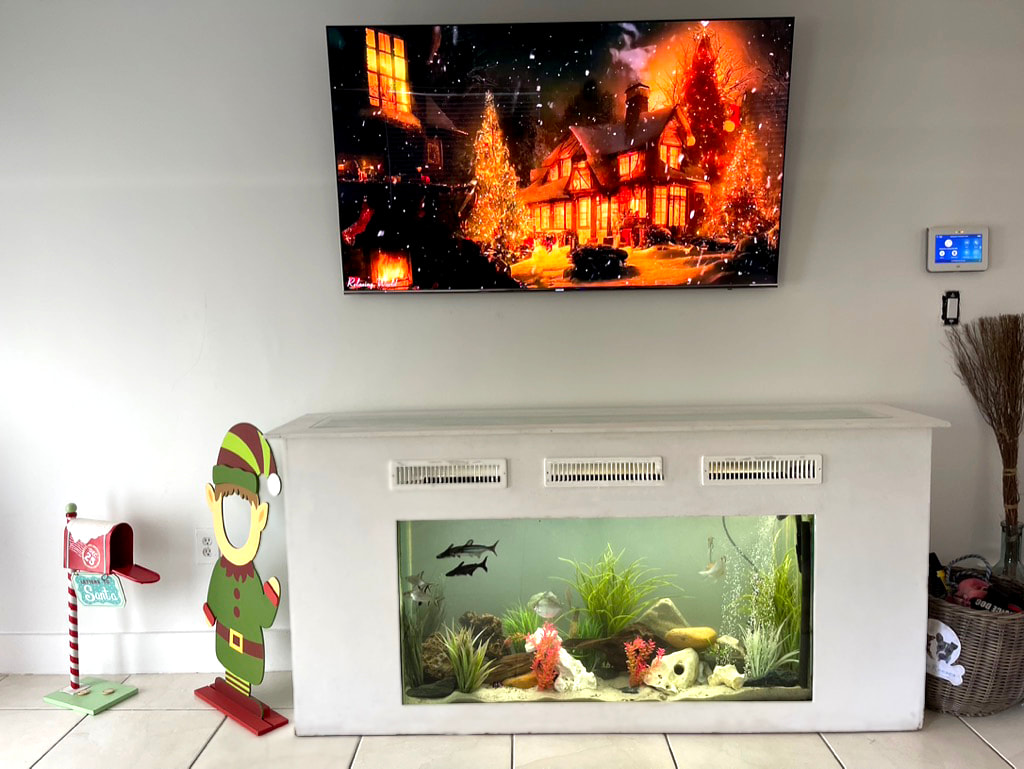
Same tank, new address. No fish lost.
General movers will move an aquarium. What they won't do is keep the biological filter alive, keep the fish oxygenated in transit, or level the tank correctly at the far end — which is why most tank losses happen on moving day rather than during the move itself. We treat a relocation as a chemistry problem with a lifting component: water reserved and reused, media kept wet, livestock bagged with oxygen, substrate and hardscape preserved so the tank restarts with its biology intact. Within about 60 miles the fish are back in their own water the same day. Cross-state moves are staged with holding containers and a longer re-cycle window.
Every visit, on the checklist.
- Pre-move site visit at both addresses
- Custom transport containers and padding
- Livestock bagging with pure oxygen
- Original water reserved and reused
- Substrate, hardscape, and media kept wet
- Equipment disconnect, labeling, and reinstall
- New site prep, leveling, and stand check
- Re-cycle monitoring plus two follow-up visits
From first call to finished tank.
Survey
We check both ends — door widths, floor load, stand and outlet placement — before a drop of water moves.
Break down
Water reserved, livestock bagged with oxygen, media kept wet, hardscape and substrate packed to preserve biology.
Transport
Glass travels empty and braced. Livestock travels climate-controlled, not in the back of a hot truck.
Reinstall
Level, refill with reserved water, restart equipment, reintroduce livestock, then two follow-up visits while the tank re-cycles.
What it costs.
Relocations are quoted per job based on gallons, distance, access at both ends, and how much livestock is in the system. Call or email us the two addresses and the tank size and we'll come out to survey it.
Common questions.
Can my regular movers move my fish tank?
They can move the glass. Keeping the livestock and biological filter alive is a separate skill set, and it's where most moving-day losses come from.
How long can fish stay bagged?
Several hours safely when bagged with pure oxygen at the right density. We plan the route so bag time stays as short as possible.
Do I have to drain the tank myself first?
No — and please don't. We reserve and reuse as much of the original water as possible, which is what protects the cycle.
Do you move tanks out of or into high-rises?
Yes. We handle service elevators, loading dock scheduling, and building COI requirements, which comes up constantly in Miami and Fort Lauderdale.
What if the tank cracks?
We inspect seams before the move and tell you if a tank is too old to travel. If a system isn't safe to move, replacing the glass and reusing everything else is usually cheaper than the risk.