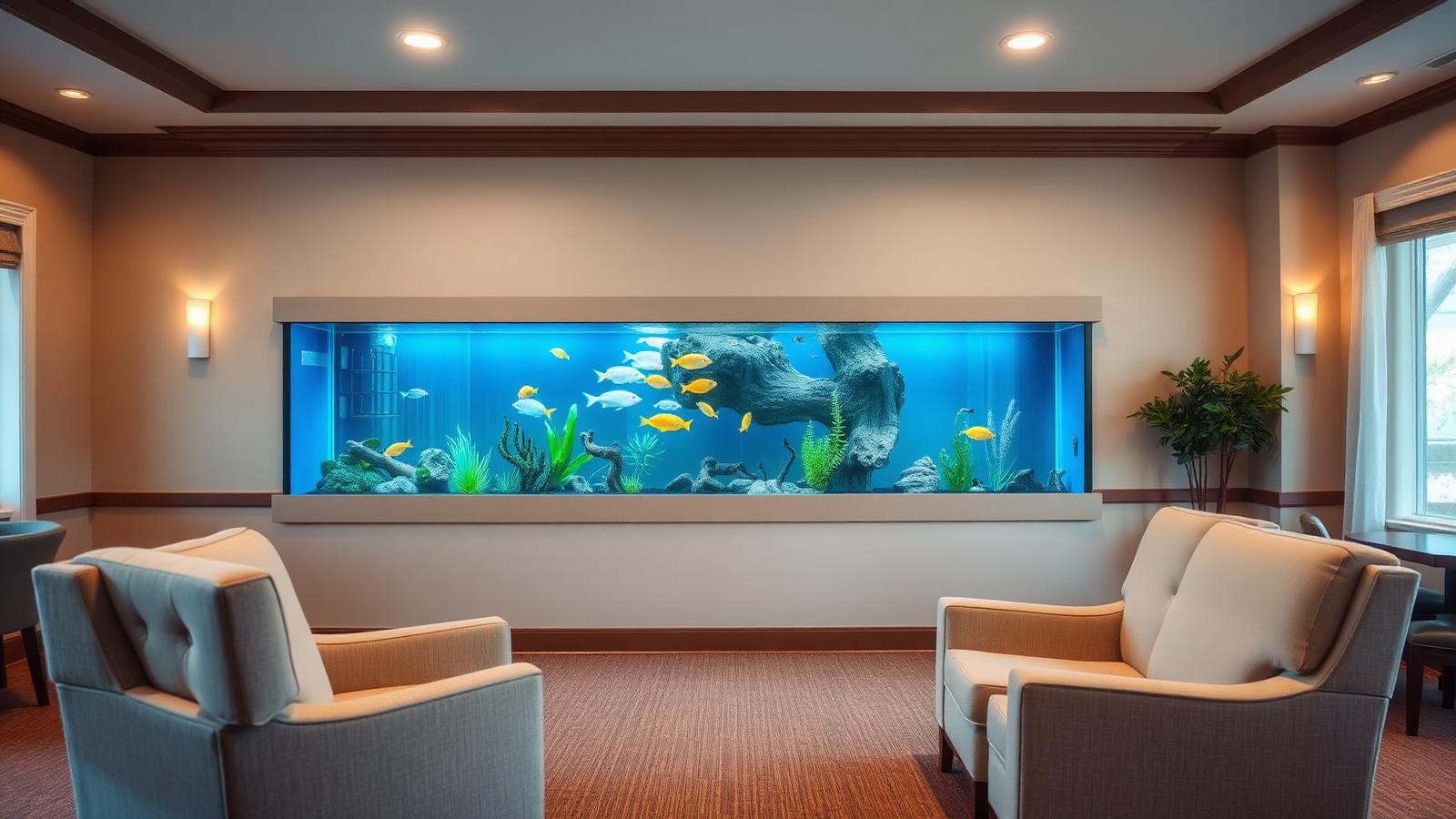
Walk into a well-run assisted-living community and you can feel the difference a good aquarium makes. Residents drift toward the tank. Conversations start. Someone who hadn''t spoken all morning names a fish. It''s not decoration — it''s a therapeutic asset, and when it''s maintained properly it earns its place in the building.
We install and service tanks across Florida for senior-living operators, memory-care units, and rehab facilities. This guide covers what actually works, what to avoid, and what a professional maintenance service looks like in this setting.
Why senior-living communities install aquariums
The research is older than most people realize. Purdue researchers Nancy Edwards and Alan Beck published a series of studies in the late 1990s and early 2000s showing that Alzheimer''s residents who ate meals in front of a large freshwater aquarium consumed more food, showed less pacing and agitation, and required fewer nutritional supplements. Subsequent studies have echoed the finding: watching fish lowers blood pressure and heart rate in people of all ages, and the effect is more pronounced with more biodiversity and movement in the tank.
For an activities director or executive director, the practical benefits are simpler:
- Calming focal point in the lobby, dining room, or memory-care common area
- Non-verbal engagement for residents with advanced dementia or aphasia
- Conversation starter for families visiting loved ones
- Marketing asset — every tour walks past it
What actually works in a memory-care setting
Not every tank belongs in senior living. A few design rules save a lot of grief later.
Size and placement. A larger tank (75 gallons and up) is more stable biologically, quieter, and easier to view from multiple seats. Mount or build it so the centerline of the water column is roughly at seated eye level — around 42–48 inches off the floor. Residents in wheelchairs should be able to see fish, not just gravel.
Low glare. Overhead fluorescents and big south-facing windows produce reflections that make the tank hard to see and, for some residents with dementia, disorienting. LED tank lighting on a timer, positioned lights in the room, and a matte back on the tank all help.
Quiet equipment. Air pumps that rattle, HOB filters that trickle, and canister filters with worn impellers all produce the kind of low-frequency noise that agitates residents and staff. We spec sump-based or high-quality canister filtration and check noise on every visit.
Safe, durable stocking. Peaceful community fish — rainbowfish, larger tetras, peaceful barbs, hardy livebearers, corydoras, a small school of angels — outlive fragile species and don''t require frequent replacement. Avoid anything aggressive (residents notice fin damage), anything jumping (open-top tanks near dementia residents are a bad idea), and anything with a two-week lifespan.
Live plants where possible. Real plants improve water quality, absorb nitrate, and look right. In memory care they''re also safer than sharp plastic decor.
Freshwater vs. saltwater in senior living
Nine times out of ten we recommend freshwater for senior-living installs. Saltwater is beautiful, but it comes with:
- Higher equipment cost and higher failure cost (a heater stuck-on can kill $2,000 of livestock overnight)
- More frequent, more technical maintenance
- Salt creep on floors and walls that housekeeping notices
- Livestock that''s harder to replace on short notice
Freshwater community tanks — planted, well-lit, biodiverse — give you 90% of the therapeutic benefit at a fraction of the operating cost and risk. The hospital lobby build we started in 2017 has been a stable freshwater community tank ever since, on two service visits per month.
Compliance and safety
Senior-living operators live with surveyors, insurance carriers, and infection-control committees. A few things we build into every install:
- GFCI-protected outlets for all tank equipment, tested on each service visit
- Spill containment — cabinet stands with sealed interiors, drip trays under sumps, absorbent mats during water changes
- No chemicals on site. We carry conditioner, test kits, and medications in our vehicles. Nothing that needs a locked cabinet stays in the building.
- Infection-control-friendly cleaning. We work around meals, disinfect our tools between accounts, and use disposable gloves and dedicated buckets — no shared equipment between facilities.
What a service contract looks like
For most senior-living clients, our contract covers:
- Two visits per month (weekly for tanks over 200 gallons or in demanding environments)
- Full water testing every visit with results logged
- 20–30% water change with RO or conditioned tap water
- Filter and equipment inspection, impeller cleaning, media rotation
- Glass and acrylic cleaning inside and out
- Plant trimming and rescape as needed
- Livestock health assessment and replacement as needed
- Single point of contact for the activities or maintenance director
- Emergency response for equipment failures
Pricing depends on tank size, stocking, and access, but a typical 90-gallon freshwater community tank in a memory-care unit runs in line with what we cover in our maintenance-cost guide.
Florida coverage
We service senior-living communities across South Florida, Southwest Florida, Tampa/St. Petersburg, and the Orlando metro. If you''re opening a new community, remodeling a common area, or you''ve inherited a tank that''s been limping along, we can quote both the install and the ongoing service in one visit.
Request a quote or see our case studies — including the 2017 hospital freshwater install that''s still running today on the same twice-monthly schedule.