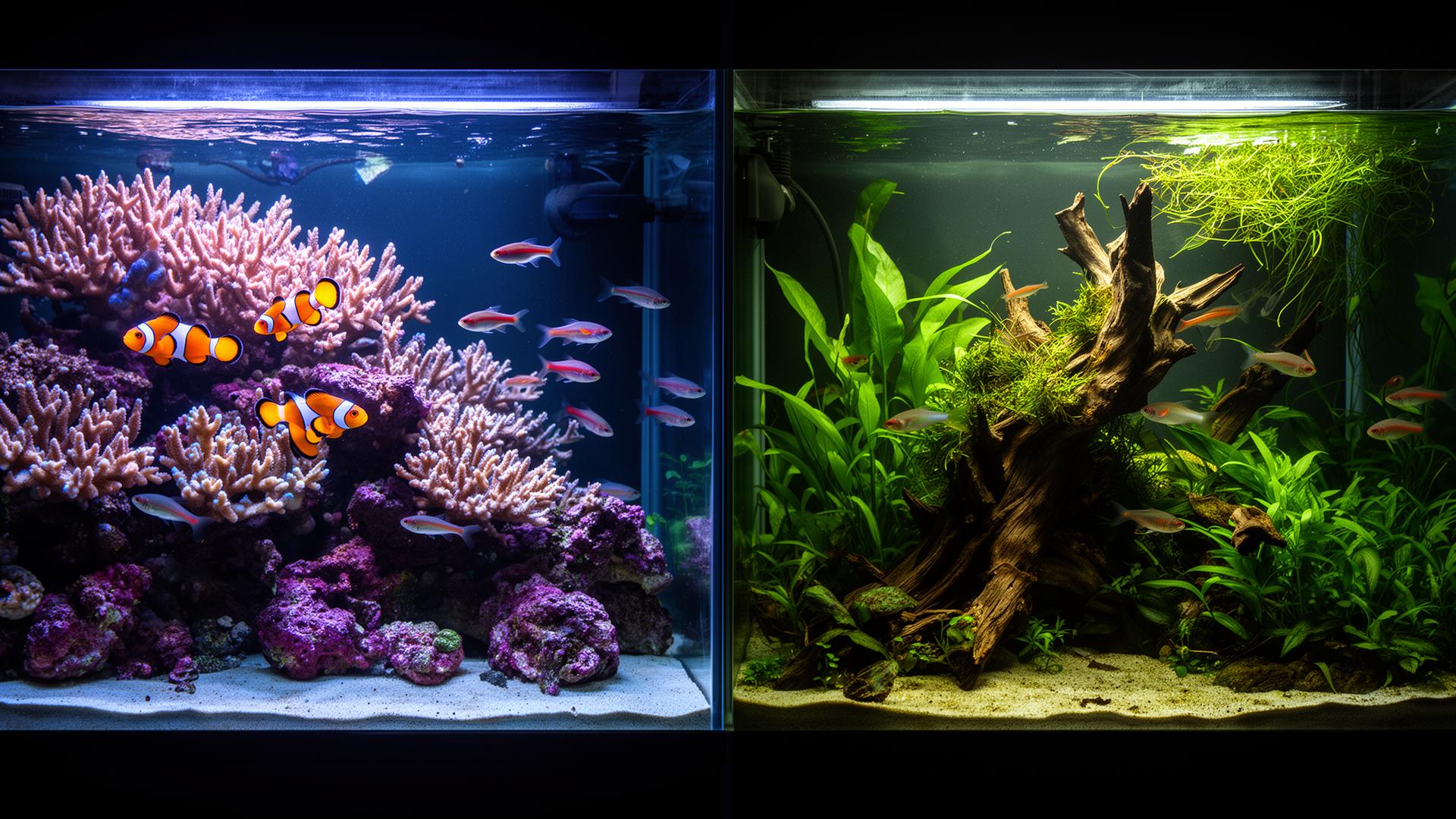
There is a moment, usually around year three of owning a reef tank, when the owner stops looking at the tank and starts looking at the protein skimmer. The skimmer is loud. The salt creep is everywhere. The chiller failed last August and a $400 acropora frag went with it. The kids never look at it anymore. The tank has stopped being a feature of the room and started being a chore on a calendar.
This is the conversation we have most often. Not "I want to upgrade my reef." It's "I want to keep an aquarium, but I want my Sundays back."
A saltwater-to-freshwater conversion is the answer most of the time. Done well, it cuts the running cost by 60–75% a month, removes the equipment that fails most often, and produces a tank that's genuinely more beautiful to most non-hobbyists. Done badly, it's an expensive way to kill a lot of fish.
Here's what the process actually looks like.
Why people convert
In 14 years of doing this in Florida, the reasons fall into three buckets:
- Cost. Salt mix, RO/DI water, additives, replacement livestock, and electricity for chillers and powerful pumps add up. A 90-gallon reef tank with a mixed garden of corals will run an owner $150–$350 per month in consumables alone before any service. The same display as a planted freshwater system runs $20–$50 in consumables.
- Time and reliability. Reef systems demand testing, dosing, equipment vigilance. A two-week vacation can erase years of work. Freshwater systems are forgiving — many of our planted displays have run untouched for a full month with no measurable harm.
- The room has changed. A 75-gallon reef in a living room makes sense when the kids are 8. It rarely makes sense when the kids are 18 and gone, the dog is older, and the homeowner just wants a quiet, beautiful object in the corner.
If any of those describe your situation, conversion is probably the right move. If you're converting because "I'm bad at reef-keeping" — pause. Most of what people call being bad at reefs is actually underspending on stable equipment. Talk to a pro before you tear the system out.
What we do, step by step
A full conversion takes two to three weeks of elapsed time. About 12–16 hours of actual hands-on work, split across visits. Here's the sequence.
Week 1: Audit and livestock plan
The first visit is mostly diagnostic. We look at:
- Tank and stand. Is the glass scratched? Is the silicone aging? Is the stand actually level? A conversion is the right moment to address any of this; once we've filled it with substrate and plants, you're committing for another five-plus years.
- Equipment. Most reef equipment doesn't carry over. The skimmer goes. The reactor goes. The chiller goes (Florida freshwater tropicals are fine at room temperature). What stays: the sump if you have one, the return pump (probably oversized but fine), and most lights — though we usually swap reef LEDs for a warmer freshwater spectrum.
- Livestock. Every animal in the tank needs a destination. Coral, fish, inverts. We rehome through local reef clubs, trusted hobbyists, and a couple of stores we have long relationships with. We don't flush anything and we don't take livestock to chain pet stores.
You'll leave this visit with a written plan: what stays, what goes, where the livestock is going, and a fixed cost.
Week 1–2: Strip
The strip is the dirty day. We come with totes, a transport vehicle, and usually one extra person. The order is:
- Pull the fish into bagged transport water.
- Pull the corals and inverts. Anything that's been on a rock for two years has to be carefully removed, not yanked.
- Drain the tank to about 4 inches.
- Remove rockwork, then drain fully.
- Vacuum out the substrate. Old reef sand is essentially a small chemistry hazard at this point and we do not reuse it.
- Acid-wash the inside of the tank to remove coralline algae and salt buildup. This is the step amateurs skip and regret six months later.
- Inspect silicone seams. Reseal anything questionable while the tank is empty.
By end of day, you have an empty, clean tank in your living room. It looks bigger than you remember.
Week 2: Design and hardscape
This is where the new tank is born. Hardscape — the arrangement of stone and driftwood — is the single biggest predictor of whether a freshwater tank looks like a hobby or like a piece of furniture.
We sketch the composition before placing anything. Then we build it dry, take a photo, take it apart, and rebuild it. Usually two or three iterations. Substrate goes in after the hardscape is final; it's a mistake to do it the other way around.
Plants go in last. We use a mix of stem plants, midground species, and a foreground carpet for most displays. For Florida clients we lean on plant species that handle hard tap water — Anubias, Java fern, crypts, Vallisneria — and skip the picky, soft-water plants that look great on Instagram but die in a Miami living room.
Week 2–3: Cycling and stocking
A freshwater tank has to cycle — establish a colony of bacteria that converts fish waste into nitrate — before it can hold fish safely. Two ways we do it:
- Fishless cycle (preferred). We dose pure ammonia and test daily. Takes 10–18 days. No livestock at risk.
- Seeded cycle. If we have an established tank we're servicing nearby, we can bring filter media from it and cut the cycle to 4–7 days.
Fish go in after cycling, in groups, with at least a week between additions for larger species. A 75-gallon tank reaches its final stocking over about a month.
30-day stability check
We stay involved for a month after the last fish goes in. Weekly water tests, livestock health checks, and one visit dedicated to fine-tuning the plants. After that, the tank rolls into a normal maintenance cadence — typically twice-monthly visits.
What it costs
The honest answer: most conversions on tanks 75–200 gallons land between $2,800 and $6,500. The variables that move the price:
- Tank size. Bigger tanks need more substrate, more hardscape, more plants, more labor.
- Equipment changes. If the existing lights and filtration carry over, the bill is lower. If we're replacing lights, sump, and return pump, it's higher.
- Livestock complexity. A reef with one clownfish and a few snails is easy to rehome. A tank with rare corals and three tangs requires more work to place responsibly.
- Tank condition. A 12-year-old tank that needs resealing costs more than a 3-year-old tank.
Against those one-time costs, the math works fast. A 90-gallon reef tank running $200/month in consumables that becomes a planted freshwater tank running $30/month saves you $2,040 a year. Most conversions pay back in 18 to 30 months and then keep saving forever.
What goes wrong when amateurs try it
We get called in to fix DIY conversions a few times a year. The common failures:
- Skipping the acid wash. Six months later, a green-brown film of coralline residue blooms across the glass and won't come off.
- Reusing reef sand. Old reef substrate buffers pH high and slowly releases trapped salt. Plants don't thrive; fish look stressed.
- Stocking before cycling. New tank syndrome kills fish in week two. The owner blames the species, restocks, and kills another wave.
- No livestock plan. Corals end up in the trash. We've seen it. Don't.
- Choosing plants by photo. South Florida tap water is hard. Most of the lush, carpet-style plants from European nature aquariums don't survive it without injected CO2 and RO water — which defeats the entire point of converting.
When NOT to convert
A few situations where we'll talk you out of it:
- The tank is under two years old and the only complaint is one piece of failing equipment. Fix the equipment.
- You genuinely enjoy reef-keeping and the cost isn't the issue. Find a service company and keep the reef.
- You want a freshwater tank that looks like a reef. That tank doesn't exist. The reason freshwater systems are calming is precisely that they're not high-contrast and high-color.
What you'll have when we're done
A tank that looks intentional. Clear water. Healthy fish moving at human-watchable speeds, not the frantic darting of small reef fish. Plants doing the work that equipment used to do. A power bill that's noticeably lower. A maintenance schedule you can ignore.
It's the tank you wanted when you bought the reef — without the part-time job.
The Sign of Aquarium has converted hundreds of saltwater systems into freshwater displays across Florida since 2011. If you're thinking about converting, request a site visit and Greg will personally walk through your system and give you a written quote within 48 hours.