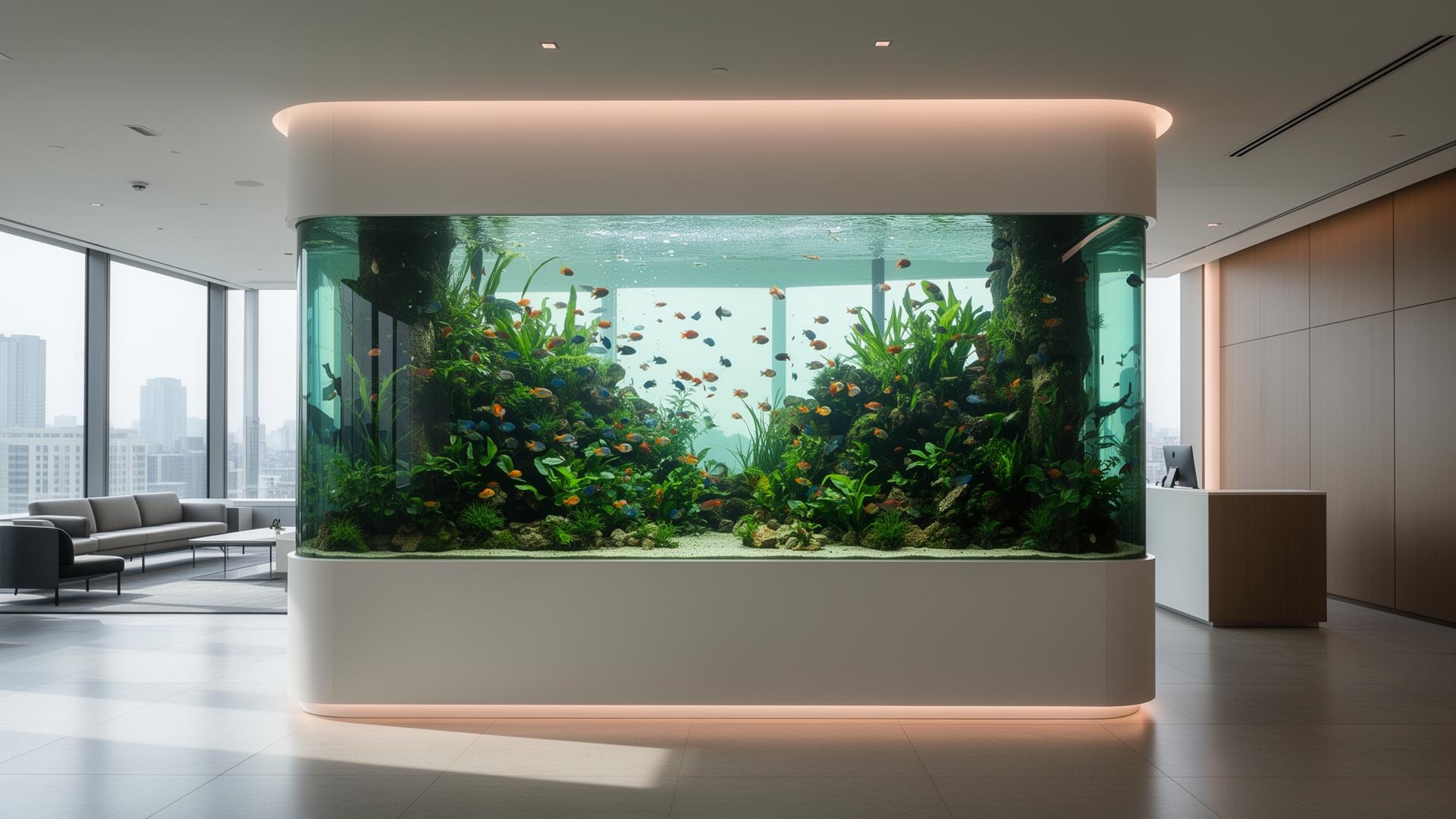
Most office aquariums get installed with enthusiasm and forgotten with embarrassment. The plant is wilting, the water is cloudy, two of the fish from the launch photo are gone, and nobody at the firm is sure who is supposed to be doing what about it.
A real service contract solves all of that and removes it from your weekly inbox. Here is what one should cover, what it should cost, and what to ask before you sign.
Why offices have aquariums in the first place
The research on aquariums in commercial settings is well-documented and surprisingly consistent. Patients in medical waiting rooms with aquariums show measurable reductions in pre-procedure anxiety. Restaurant guests stay longer at tables near display tanks. Open-plan offices with aquariums report higher perceived workplace quality on employee surveys. Whether the effect is the movement, the color, the white noise of water, or some combination of all three, the conclusion is the same: a well-maintained aquarium does work that no other piece of furniture can do.
The operative phrase is well-maintained. A neglected tank does the opposite — it broadcasts inattention.
What a service contract should cover
A commercial maintenance contract is not a residential plan with a different invoice address. The expectations are different.
Scheduled service
Every contract specifies:
- Visit frequency — weekly is standard for most commercial displays under 200 gallons, biweekly works for very lightly stocked larger systems
- Visit window — typically a two- or three-hour window on a fixed day of the week
- Service duration — what to expect on a normal visit
- After-hours availability — restaurants and healthcare facilities often require service before opening or after close
Scope of work per visit
The same checklist as a residential service (testing, glass, gravel, filter, water change, equipment, dosing, log) plus a few commercial-specific items:
- Public-facing presentation. Every visible surface is wiped, decor is symmetrically arranged, plants are pruned for shape, not just health. The tank should look like a designed object, not a science project.
- Livestock replacement. Most commercial contracts include guaranteed fish replacement at no additional cost. Office tanks tend to lose fish faster than residential tanks (HVAC, light cycles, ambient noise, occasional well-meaning feeding by staff) and the contract should absorb that.
- Documentation for facilities. A digital log emailed after each visit. Anything the facilities team needs to know — electrical issues, water source problems, scheduling conflicts — gets flagged in writing.
Equipment and consumables
The contract should specify who pays for what. Standard commercial structure:
- Included: all consumables (dechlorinator, fertilizers, test reagents, filter media, food, salt for marine systems)
- Included: routine repairs under a stated dollar amount per visit (typically $50 to $100), so a failing heater or impeller does not require a separate call
- Not included: major equipment replacement (return pumps, lighting fixtures, chillers, controllers), approved separately
- Not included: custom livestock requests outside the standard stocking plan
Response time for problems
This is the part that matters when a return pump fails on a Friday afternoon. A commercial contract should specify response time:
- Standard issue (livestock loss, minor algae, equipment performance): addressed at next scheduled visit
- Urgent issue (water leak, complete equipment failure, mass die-off): response within 24 hours
- Emergency (active leak threatening the floor, electrical hazard): response within 4 hours during business hours
If a contract does not put these in writing, the response time is whenever the technician feels like it.
What it costs
Commercial maintenance in South Florida runs higher than residential per gallon, because the contract includes livestock guarantees, faster response times, and higher presentation standards. Realistic monthly ranges:
| Tank size | Setting | Monthly contract |
|---|---|---|
| 55 to 90 gal | Office lobby, dental waiting room | $280 to $450 |
| 90 to 150 gal | Medical office, mid-sized restaurant | $400 to $700 |
| 180 to 240 gal | Corporate lobby, fine dining, executive suite | $650 to $1,100 |
| 300 to 500 gal | Large lobby installations, hospital atriums | $1,000 to $2,000+ |
| Marine reef systems | Any size | Roughly 1.5x to 2x freshwater equivalent |
These numbers assume weekly service and include everything in the scope above. They do not include the initial system design, install, or any structural work.
Questions to ask before signing
Most aquarium service companies will quote a number over the phone in five minutes. The number is rarely the problem — the gaps in what it covers are. Before signing anything:
- How long have you been servicing commercial accounts? Residential-only services often underestimate the response-time obligations of a commercial contract and over-promise.
- Can I see your service log template? A real commercial service has a documented template. Companies that "send a quick email" do not.
- What is your livestock replacement policy? Specifically, are fish replaced at no charge, partial charge, or full charge? What is the timeline?
- Who handles emergency response, and what is the maximum response time? Get a number, in writing.
- What happens if my regular technician is out? A real service has multiple technicians; a one-person operation has none.
- Are you licensed and insured? Required for any vendor working in a medical or hospitality setting. Ask for the certificate of insurance.
- What is the cancellation policy? Month-to-month is standard for commercial. Annual contracts with cancellation penalties are a yellow flag.
- Can I talk to two of your current commercial clients? Anyone with five-plus years in this business has clients willing to vouch for them.
What gets a tank pulled out of an office
About one in every twenty commercial tanks we are asked to take over has been so badly neglected by previous service that the client wants the entire system removed instead of restored. The pattern is consistent — months of "we will fix it next visit," fish that disappeared and were never replaced, water that nobody has tested in a year, a controller flashing alarms that nobody is reading. By the time the office manager calls, the tank has become a liability rather than an amenity.
The opposite is also common. Offices that have had consistent, well-documented service for years usually keep their tanks indefinitely, often upgrading to larger or more ambitious systems when they renovate. The difference between the two outcomes is almost entirely about the service, not the tank.
If you are evaluating service for your office
If you currently have a tank and the service is not working — or you are planning a new install and want to understand the operating cost before you commit — reach out. We will give you a written scope and a realistic monthly number, no pressure to sign, and a frank assessment of whether the tank you are considering is the right size and type for the space.
For an overview of where we work, see our service area pages. For specifics on therapeutic installations, see our notes on aquariums in assisted living.