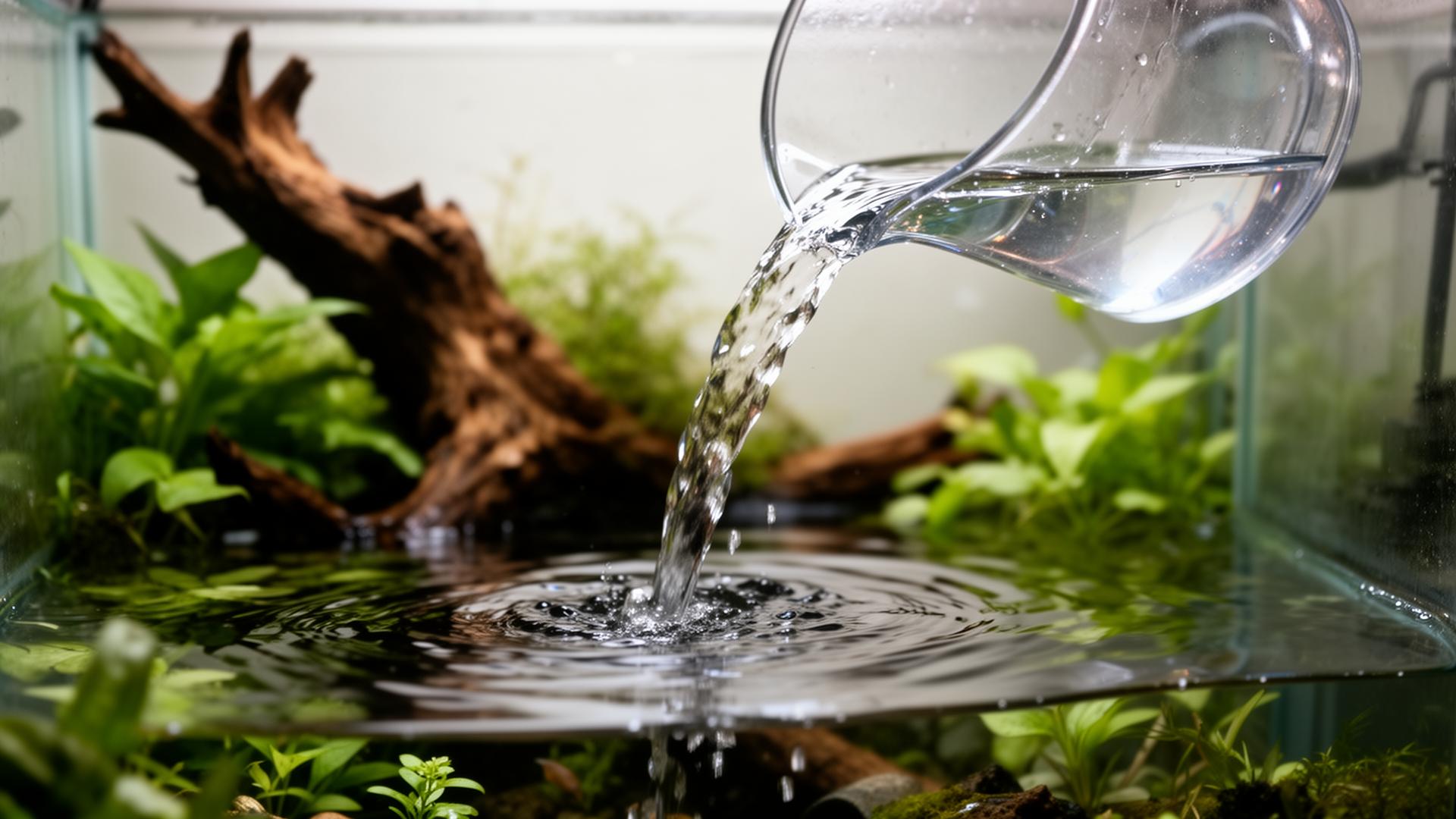
"Once a week" is the answer you will find on every forum thread and every fish-store shelf-talker. It is also wrong about half the time.
We service somewhere north of two hundred aquariums across Broward and Miami-Dade. The water-change schedule on a lightly stocked 75-gallon planted tank in a quiet living room is not the same as the schedule on a 300-gallon office display with a pair of fancy goldfish. Anyone who tells you otherwise is selling you a calendar, not advice.
Here is how we actually decide.
The only number that matters: nitrate
Aquarium water turns toxic in three stages. Fish produce ammonia. Beneficial bacteria convert ammonia to nitrite. A second wave of bacteria converts nitrite to nitrate. In a cycled tank, ammonia and nitrite should read zero almost all the time. Nitrate is the one that builds up, and it is the one a water change actually removes.
For most freshwater displays, the working target is:
- Under 20 ppm nitrate for sensitive fish (discus, German rams, wild-caught species, most planted-tank communities)
- Under 40 ppm nitrate for hardy community tanks (tetras, livebearers, barbs, danios)
- Under 80 ppm nitrate is the upper bound where most fish stay healthy long-term
If your nitrate climbs from 10 ppm to 40 ppm in seven days, you need a weekly water change. If it climbs from 10 ppm to 20 ppm in fourteen days, you need a biweekly water change. The tank tells you the schedule. You do not pick it.
How much water, not just how often
The two numbers — frequency and volume — work together. Two common schedules cover most tanks we maintain:
- 25% weekly. The standard for moderately stocked community tanks. Removes enough nitrate to keep readings in a safe range, dilutes dissolved organics that test kits do not measure, and replenishes trace minerals.
- 30 to 40% biweekly. Works for lightly stocked tanks, heavily planted tanks (plants consume nitrate), and tanks with oversized filtration.
We rarely recommend changing more than 50% at once on an established tank without a specific reason. Large swings in temperature, pH, or hardness stress fish more than a slightly elevated nitrate reading does.
What changes the schedule
A handful of variables move the dial. If two or more apply to you, shorten the interval or increase the volume.
- High bioload. A 55-gallon with a single oscar produces more waste than the same tank with twenty neons. Big fish, messy fish (oscars, plecos, goldfish), and overstocked tanks all need more frequent changes.
- Heavy feeding. Uneaten food breaks down into ammonia. If you feed twice a day or have an automatic feeder, your nitrate rises faster.
- Light filtration. A hang-on-back rated for 30 gallons running on a 55-gallon tank is going to fall behind. Undersized filtration shows up first as cloudy water, then as elevated nitrate.
- Live plants. Plants pull nitrate out of the water as fertilizer. A densely planted tank can go two to three weeks between water changes without nitrate climbing.
- Tap water quality. South Florida tap water comes out of the faucet at roughly 10 to 20 ppm nitrate before it ever hits your tank. If your tap is high, you are starting from a worse baseline and need to change water more often, or switch to RO/DI for top-offs.
What "water change" actually means
A water change is not just siphoning out the old and pouring in the new. Done correctly, every water change includes:
- Gravel vacuuming. Detritus that settles in substrate is the slow-release fertilizer for algae and the slow-release toxin for fish. A turkey baster for planted tanks, a proper siphon for everything else.
- Filter check. Rinse mechanical media in tank water (never tap water — chlorine kills the bacteria you spent months growing). Replace if it is falling apart.
- Glass and decor. Algae scraper across the inside glass, soft cloth on the outside. Decor that is heavily coated comes out, gets a hot water rinse, and goes back.
- Dechlorinator. Always. Even in cities with chloramine, a standard conditioner like Seachem Prime handles it.
- Temperature match. New water should be within two degrees of tank water. A thermometer is faster than guessing.
If a "water change" only involves a hose and a bucket and takes seven minutes, you are not actually maintaining the tank. You are just diluting it.
When the calendar is wrong
There are situations where you ignore the schedule entirely and change water now:
- Ammonia or nitrite reading above zero. Anything above zero means the biological filter is failing. Change 50% immediately, then again the next day, and figure out what broke.
- Fish gasping at the surface. Could be low oxygen, could be ammonia poisoning, could be a temperature spike. Water change first, diagnose second.
- Visible film on the surface. Protein film usually means waste is accumulating faster than the filter can handle. Change water and increase surface agitation.
- A fish died and you cannot find the body. Decomposition releases ammonia quickly. Find the fish if you can, change 30 to 50% of the water regardless.
A practical starting point
If you do not own a nitrate test kit, buy one this week. The API freshwater master kit costs around thirty dollars, lasts two years, and tells you everything you need to know.
Until you have readings, start here:
- New tank, first 8 weeks: 25% weekly, no exceptions. Tanks under three months old are the most fragile they will ever be.
- Established community tank: 25% weekly is the safe default. Adjust based on nitrate readings after a month.
- Heavily planted, lightly stocked: 30% every two weeks, watch nitrate.
- High-bioload tank (oscars, large cichlids, goldfish): 30 to 40% twice a week if you can manage it. These fish are nitrate factories.
Then test before and after every water change for a month. Within four weeks you will have a schedule that fits your tank, not someone else's tank from a YouTube video.
When you stop wanting to do this yourself
Some people enjoy water changes — there is something honest about clean water and a quiet Sunday morning with a siphon. Most people do not. If your weekly maintenance has become "I will do it tomorrow" for three weeks running, the tank is already starting to drift. That is when most of our residential clients call us. We handle the schedule, the testing, and the parts of the job that are easy to put off, and the tank stops being a chore.
If you are in South Florida and your tank has stopped being fun, get in touch. We will give you an honest read on what your schedule should be — and whether you actually need us, or just a slightly bigger filter.